Neutron Star

Neutron star

Degenerate stellar remnant


A neutron star is the collapsed core of agiant star which before collapse had a total mass of between 10 and 29 solar masses. Neutron stars are the smallest and densest stars, excluding black holesand hypothetical white holes, quark stars, and strange stars. Neutron stars have a radius on the order of 10 kilometres (6.2 mi) and a mass of about 1.4 solar masses. They result from thesupernova explosion of a massive star, combined with gravitational collapse, that compresses the core past white dwarf star density to that of atomic nuclei.

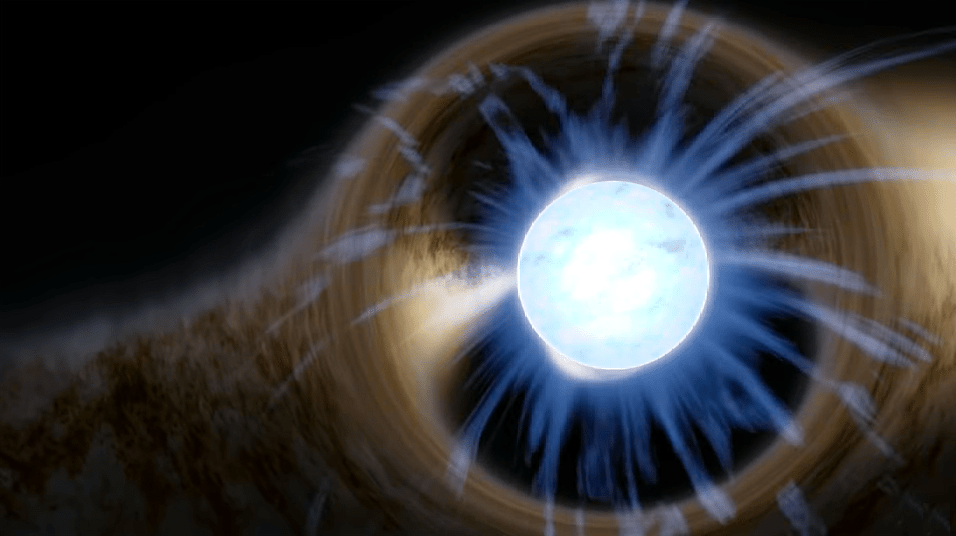
Simulated view of a neutron star. Due to its strong gravity, the background is gravitationally lensed, making it appear distorted.
Radiation from the pulsar PSR B1509-58, a rapidly spinning neutron star, makes nearby gas glow in X-rays (gold, from Chandra) and illuminates the rest of the nebula, here seen ininfrared (blue and red, from WISE).

Once formed, they no longer actively generate heat, and cool over time; however, they may still evolve further through collision or accretion. Most of the basic models for these objects imply that neutron stars are composed almost entirely of neutrons (subatomic particles with no net electrical charge and with slightly larger mass than protons); the electrons and protons present in normal matter combine to produce neutrons at the conditions in a neutron star. Neutron stars are partially supported against further collapse by neutron degeneracy pressure, a phenomenon described by the Pauli exclusion principle, just as white dwarfs are supported against collapse by electron degeneracy pressure. However neutron degeneracy pressure is not by itself sufficient to hold up an object beyond 0.7M and repulsive nuclear forces play a larger role in supporting more massive neutron stars. If the remnant star has a massexceeding the Tolman–Oppenheimer–Volkoff limit of around 2 solar masses, the combination of degeneracy pressure and nuclear forces is insufficient to support the neutron star and it continues collapsing to form a black hole.

Neutron stars that can be observed are very hot and typically have a surface temperature of around 600000 K. They are so dense that a normal-sized matchbox containing neutron-star material would have a weight of approximately 3 billion tonnes, the same weight as a 0.5 cubic kilometre chunk of the Earth (a cube with edges of about 800 metres) from Earth’s surface.Their magnetic fields are between 108and 1015 (100 million to 1 quadrillion) times stronger than Earth’s magnetic field. The gravitational field at the neutron star’s surface is about 2×10¹¹(200 billion) times that of Earth’s gravitational field.

As the star’s core collapses, its rotation rate increases as a result ofconservation of angular momentum, and newly formed neutron stars hence rotate at up to several hundred times per second. Some neutron stars emit beams of electromagnetic radiation that make them detectable as pulsars. Indeed, the discovery of pulsars by Jocelyn Bell Burnell and Antony Hewish in 1967 was the first observational suggestion that neutron stars exist. The radiation from pulsars is thought to be primarily emitted from regions near their magnetic poles. If the magnetic poles do not coincide with the rotational axis of the neutron star, the emission beam will sweep the sky, and when seen from a distance, if the observer is somewhere in the path of the beam, it will appear as pulses of radiation coming from a fixed point in space (the so-called “lighthouse effect”). The fastest-spinning neutron star known is PSR J1748-2446ad, rotating at a rate of 716 times a second or 43,000revolutions per minute, giving a linear speed at the surface on the order of0.24 c (i.e., nearly a quarter the speed of light).

There are thought to be around 100 million neutron stars in the Milky Way, a figure obtained by estimating the number of stars that have undergone supernova explosions. However, most are old and cold and radiate very little; most neutron stars that have been detected occur only in certain situations in which they do radiate, such as if they are a pulsar or part of a binary system. Slow-rotating and non-accreting neutron stars are almost undetectable; however, since the Hubble Space Telescopedetection of RX J185635−3754, a few nearby neutron stars that appear to emit only thermal radiation have been detected. Soft gamma repeaters are conjectured to be a type of neutron star with very strong magnetic fields, known as magnetars, or alternatively, neutron stars with fossil disks around them.

Neutron stars in binary systems can undergo accretion which typically makes the system bright in X-rays while the material falling onto the neutron star can form hotspots that rotate in and out of view in identified X-ray pulsar systems. Additionally, such accretion can “recycle” old pulsars and potentially cause them to gain mass and spin-up to very fast rotation rates, forming the so-calledmillisecond pulsars. These binary systems will continue to evolve, and eventually the companions can becomecompact objects such as white dwarfs or neutron stars themselves, though other possibilities include a complete destruction of the companion throughablation or merger. The merger of binary neutron stars may be the source ofshort-duration gamma-ray bursts and are likely strong sources of gravitational waves. In 2017, a direct detection (GW170817) of the gravitational waves from such an event was made, and gravitational waves have also been indirectly detected in a system where two neutron stars orbit each other.

Formation

Simplistic representation of the formation of neutron stars.

Any main-sequence star with an initial mass of above 8 times the mass of the sun (8 M) has the potential to produce a neutron star. As the star evolves away from the main sequence, subsequent nuclear burning produces an iron-rich core. When all nuclear fuel in the core has been exhausted, the core must be supported by degeneracy pressure alone. Further deposits of mass from shell burning cause the core to exceed the Chandrasekhar limit. Electron-degeneracy pressure is overcome and the core collapses further, sending temperatures soaring to over 5×10⁹ K. At these temperatures,photodisintegration (the breaking up of iron nuclei into alpha particles by high-energy gamma rays) occurs. As the temperature climbs even higher, electrons and protons combine to form neutrons via electron capture, releasing a flood of neutrinos. When densities reach nuclear density of 4×10¹⁷ kg/m3, a combination of strong force repulsion and neutron degeneracy pressure halts the contraction. The infalling outer envelope of the star is halted and flung outwards by a flux of neutrinos produced in the creation of the neutrons, becoming a supernova. The remnant left is a neutron star. If the remnant has a mass greater than about 3 M, it collapses further to become a black hole.

As the core of a massive star is compressed during a Type II supernovaor a Type Ib or Type Ic supernova, and collapses into a neutron star, it retains most of its angular momentum. But, because it has only a tiny fraction of its parent’s radius (and therefore itsmoment of inertia is sharply reduced), a neutron star is formed with very high rotation speed, and then over a very long period it slows. Neutron stars are known that have rotation periods from about 1.4 ms to 30 s. The neutron star’s density also gives it very high surface gravity, with typical values ranging from 1012 to 1013 m/s2 (more than 1011 times that of Earth). One measure of such immense gravity is the fact that neutron stars have an escape velocity ranging from 100,000 km/s to 150,000 km/s, that is, from a third to half the speed of light. The neutron star’s gravity accelerates infalling matter to tremendous speed. The force of its impact would likely destroy the object’s component atoms, rendering all the matter identical, in most respects, to the rest of the neutron star.

Properties

Mass and temperature

A neutron star has a mass of at least 1.1solar masses (M). The upper limit of mass for a neutron star is called theTolman–Oppenheimer–Volkoff limit and is generally held to be around 2.1 M, but a recent estimate puts the upper limit at 2.16 M. The maximum observed mass of neutron stars is about2.14 M for PSR J0740+6620 discovered in September, 2019. Compact starsbelow the Chandrasekhar limit of1.39 M are generally white dwarfswhereas compact stars with a mass between 1.4 M and 2.16 M are expected to be neutron stars, but there is an interval of a few tenths of a solar mass where the masses of low-mass neutron stars and high-mass white dwarfs can overlap. It is thought that beyond 2.16 M the stellar remnant will overcome the strong force repulsion andneutron degeneracy pressure so thatgravitational collapse will occur to produce a black hole, but the smallest observed mass of a stellar black hole is about 5 M. Between 2.16 M and5 M, hypothetical intermediate-mass stars such as quark stars andelectroweak stars have been proposed, but none have been shown to exist.

The temperature inside a newly formed neutron star is from around 1011 to1012 kelvin. However, the huge number of neutrinos it emits carry away so much energy that the temperature of an isolated neutron star falls within a few years to around 106 kelvin. At this lower temperature, most of the light generated by a neutron star is in X-rays.

Some researchers have proposed a neutron star classification system usingRoman numerals (not to be confused with the Yerkes luminosity classes for non-degenerate stars) to sort neutron stars by their mass and cooling rates: type I for neutron stars with low mass and cooling rates, type II for neutron stars with higher mass and cooling rates, and a proposed type III for neutron stars with even higher mass, approaching2 M, and with higher cooling rates and possibly candidates for exotic stars.

Density and pressure

Neutron stars have overall densities of3.7×1017 to 5.9×10¹⁷ kg/m3 (2.6×10¹⁴to 4.1×10¹⁴ times the density of the Sun), which is comparable to the approximate density of an atomic nucleus of 3×10¹⁷ kg/m3. The neutron star’s density varies from about1×109 kg/m3 in the crust—increasing with depth—to about 6×10¹⁷ or8×1017 kg/m3 (denser than an atomic nucleus) deeper inside. A neutron star is so dense that one teaspoon (5milliliters) of its material would have a mass over 5.5×10¹² kg, about 900 times the mass of the Great Pyramid of Giza. In the enormous gravitational field of a neutron star, that teaspoon of material would weigh 1.1×1025 N, which is 15 times what the Moon would weigh if it were placed on the surface of the Earth. The entire mass of the Earth at neutron star density would fit into a sphere of 305 m in diameter (the size of the Arecibo Observatory). The pressure increases from 3.2×1031 to1.6×1034 Pa from the inner crust to the center.

The equation of state of matter at such high densities is not precisely known because of the theoretical difficulties associated with extrapolating the likely behavior of quantum chromodynamics,superconductivity, and superfluidity of matter in such states. The problem is exacerbated by the empirical difficulties of observing the characteristics of any object that is hundreds of parsecs away, or farther.

A neutron star has some of the properties of an atomic nucleus, including density (within an order of magnitude) and being composed ofnucleons. In popular scientific writing, neutron stars are therefore sometimes described as “giant nuclei”. However, in other respects, neutron stars and atomic nuclei are quite different. A nucleus is held together by the strong interaction, whereas a neutron star is held together by gravity. The density of a nucleus is uniform, while neutron stars are predicted to consist of multiple layers with varying compositions and densities.

Magnetic field

The magnetic field strength on the surface of neutron stars ranges from c. 104 to 1011 tesla. These are orders of magnitude higher than in any other object: for comparison, a continuous 16 T field has been achieved in the laboratory and is sufficient to levitate a living frog due to diamagnetic levitation. Variations in magnetic field strengths are most likely the main factor that allows different types of neutron stars to be distinguished by their spectra, and explains the periodicity of pulsars.

The neutron stars known as magnetarshave the strongest magnetic fields, in the range of 108 to 1011 tesla, and have become the widely accepted hypothesis for neutron star types soft gamma repeaters (SGRs) andanomalous X-ray pulsars (AXPs). The magnetic energy density of a 108 T field is extreme, exceeding the mass−energydensity of ordinary matter. Fields of this strength are able to polarize the vacuum to the point that the vacuum becomes birefringent. Photons can merge or split in two, and virtual particle-antiparticle pairs are produced. The field changes electron energy levels and atoms are forced into thin cylinders. Unlike in an ordinary pulsar, magnetar spin-down can be directly powered by its magnetic field, and the magnetic field is strong enough to stress the crust to the point of fracture. Fractures of the crust cause starquakes, observed as extremely luminous millisecond hard gamma ray bursts. The fireball is trapped by the magnetic field, and comes in and out of view when the star rotates, which is observed as a periodic soft gamma repeater (SGR) emission with a period of 5–8 seconds and which lasts for a few minutes.

The origins of the strong magnetic field are as yet unclear. One hypothesis is that of “flux freezing”, or conservation of the original magnetic flux during the formation of the neutron star. If an object has a certain magnetic flux over its surface area, and that area shrinks to a smaller area, but the magnetic flux is conserved, then the magnetic field would correspondingly increase. Likewise, a collapsing star begins with a much larger surface area than the resulting neutron star, and conservation of magnetic flux would result in a far stronger magnetic field. However, this simple explanation does not fully explain magnetic field strengths of neutron stars.

Gravity and equation of state

Gravitational light deflection at a neutron star. Due to relativistic light deflection more than half of the surface is visible (each grid patch here represents 30 degrees by 30 degrees). Innatural units, the mass of the depicted star is 1 and its radius 4, or twice its Schwarzschild radius.

The gravitational field at a neutron star’s surface is about 2×10¹¹ times stronger than on Earth, at around 2.0×10¹² m/s2. Such a strong gravitational field acts as a gravitational lens and bends the radiation emitted by the neutron star such that parts of the normally invisible rear surface become visible. If the radius of the neutron star is 3GM/c2 or less, then the photons may be trapped in an orbit, thus making the whole surface of that neutron star visible from a single vantage point, along with destabilizing photon orbits at or below the 1 radius distance of the star.

A fraction of the mass of a star that collapses to form a neutron star is released in the supernova explosion from which it forms (from the law of mass–energy equivalence, E = mc2). The energy comes from the gravitational binding energy of a neutron star.

Hence, the gravitational force of a typical neutron star is huge. If an object were to fall from a height of one meter on a neutron star 12 kilometers in radius, it would reach the ground at around 1400 kilometers per second. However, even before impact, the tidal force would cause spaghettification, breaking any sort of an ordinary object into a stream of material.

Because of the enormous gravity, time dilation between a neutron star and Earth is significant. For example, eight years could pass on the surface of a neutron star, yet ten years would have passed on Earth, not including the time-dilation effect of its very rapid rotation.

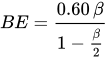
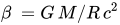
Neutron star relativistic equations of state describe the relation of radius vs. mass for various models. The most likely radii for a given neutron star mass are bracketed by models AP4 (smallest radius) and MS2 (largest radius). BE is the ratio of gravitational binding energy mass equivalent to the observed neutron star gravitational mass of “M” kilograms with radius “R” meters,

Given current values

and star masses “M” commonly reported as multiples of one solar mass,

then the relativistic fractional binding energy of a neutron star is

A 2 M neutron star would not be more compact than 10,970 meters radius (AP4 model). Its mass fraction gravitational binding energy would then be 0.187, −18.7% (exothermic). This is not near 0.6/2 = 0.3, −30%.

The equation of state for a neutron star is not yet known. It is assumed that it differs significantly from that of a white dwarf, whose equation of state is that of a degenerate gas that can be described in close agreement with special relativity. However, with a neutron star the increased effects of general relativity can no longer be ignored. Several equations of state have been proposed (FPS, UU, APR, L, SLy, and others) and current research is still attempting to constrain the theories to make predictions of neutron star matter.This means that the relation between density and mass is not fully known, and this causes uncertainties in radius estimates. For example, a 1.5 M neutron star could have a radius of 10.7, 11.1, 12.1 or 15.1 kilometers (for EOS FPS, UU, APR or L respectively).

Structure

Cross-section of neutron star. Densities are in terms of ρ0 the saturation nuclear matter density, where nucleons begin to touch.

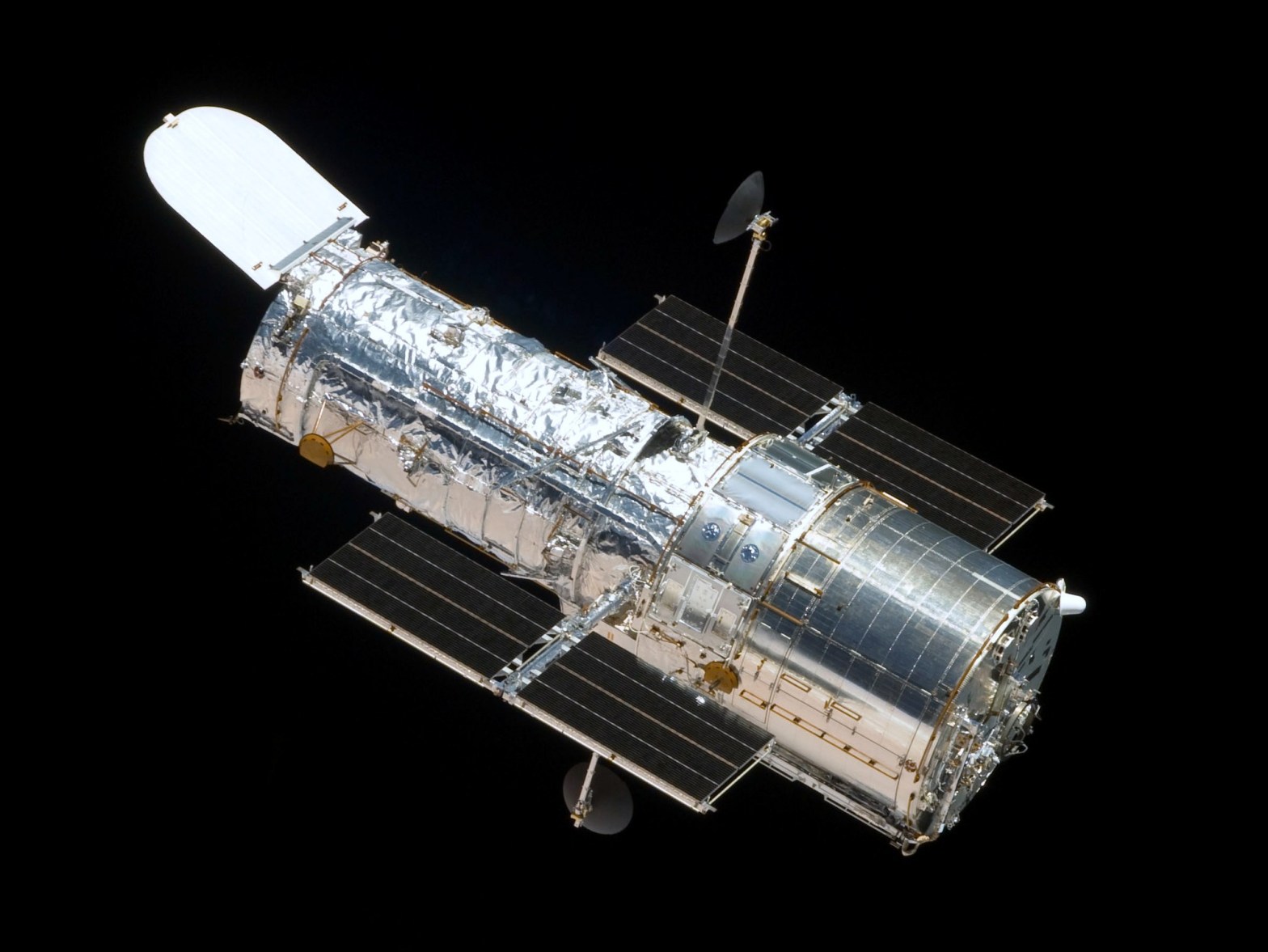
Hubble Space Telescope

হাবল স্পেস টেলিস্কোপ

স্পেস টেলিস্কোপ


হাবল স্পেস টেলিস্কোপ (ইংরেজি: Hubble Space Telescope), সংক্ষেপে HST, মহাকাশেপৃথিবীর মাধ্যাকর্ষণের আয়ত্তে ভাসমান পৃথিবীর প্রথম এবং একমাত্র (প্রেক্ষিত ২০১২) দূরবীক্ষণ যন্ত্র, যা এপর্যন্ত (২০১২) সবচেয়ে দূরাবধি দেখার জন্য মানুষের তৈরি শ্রেষ্ঠ বীক্ষণ যন্ত্র। এমনকি পরিষ্কার দৃশ্য দেখার ক্ষেত্রেও এগিয়ে আছে টেলিস্কোপটি, এর উজ্জ্বল দৃশ্য দেখার ক্ষমতা হলো ০.০৫ আর্কসেকেন্ড।দ্রুত তথ্য: অবস্থান, ওয়েবসাইট …

হাবল স্পেস দূরবীক্ষণ (এইচএসটি) হল একটি স্পেস দূরবীক্ষণ যা 1990 এর কম পৃথিবীর কক্ষপথের মধ্যে চালু করা হয় এবং অপারেশন অবশেষ। যদিও প্রথম স্পেস দূরবীক্ষণ নয়, হাবলটি সর্ববৃহৎ এবং সবচেয়ে বহুমুখী, এবং এটি একটি অত্যাবশ্যক গবেষণা সরঞ্জাম এবং জ্যোতির্বিজ্ঞানের জন্য একটি জনসাধারণের স্বীকৃতি হিসাবে পরিচিত। এইচএসটি জ্যোতির্বিজ্ঞানী এডউইন হাবলের নামে নামকরণ করা হয়, এবং এটি নাসা’র গ্রেট মানমন্দিরের এক, কম্পটন গামা রশ্মি মানমন্দির, চন্দ্র এক্স-রে মানমন্দির এবং স্পিৎজার স্পেস দূরবীক্ষণ সাথে।

একটি 2.4-মিটার (7.9 ফুট) আয়না সহ, হাবলের চারটি প্রধান যন্ত্র দৃশ্যমান এবং নিকটবর্তী অতিবেগুনী, পর্যবেক্ষণ এবং নিকটবর্তী অণ্বেষণ বর্ণে পর্যবেক্ষণ করে। পৃথিবীর বায়ুমণ্ডলে বিক্রির বাইরে হাবলের কক্ষপথটি অত্যন্ত উচ্চ-রেজোলিউশনের ছবি গ্রহণ করতে দেয়, যা স্থল-ভিত্তিক টেলিস্কোপের তুলনায় যথেষ্ট নিম্নতর পটভূমি লাইট। হাবল বেশিরভাগ বিস্তারিত দৃশ্যমান আলোর চিত্রই রেকর্ড করেছেন, যা স্থান ও সময়কে গভীর দৃষ্টিতে দেখতে দেয়। হাবলের অনেক পর্যবেক্ষণ জ্যোতির্বিজ্ঞানে বিপ্লব সৃষ্টি করেছে, যেমন সঠিকভাবে মহাবিশ্বের সম্প্রসারণের হার নির্ণয় করা।

এইচএসটিটি ইউনাইটেড স্টেটস স্পেস এজেন্সি নাসা দ্বারা নির্মিত হয়েছিল, ইউরোপীয় স্পেস এজেন্সি থেকে অবদান। স্পেস টেলিস্কোপ সায়েন্স ইনস্টিটিউট (STScI) হাবল এর লক্ষ্যগুলি নির্বাচন করে এবং ফলাফলগুলি তথ্যগুলি প্রক্রিয়া করে, যখন গডার্ড স্পেস ফ্লাইট সেন্টার মহাকাশযানটি নিয়ন্ত্রণ করে।

স্পেস টেলিস্কোপগুলি 19২3 সালের প্রথম দিকে প্রস্তাবিত হয়েছিল। 1983 সালে প্রস্তাবিত শুরু করা সাথে 1970-এর দশকে হাবলকে অর্থায়ন করা হয়েছিল, কিন্তু প্রকল্পটি প্রযুক্তিগত বিলম্ব, বাজেট সমস্যা, এবং চ্যালেঞ্জার দুর্যোগ (1986) দ্বারা আক্রান্ত হয়েছিল। অবশেষে 1990 সালে চালু হয়, পাওয়া গেছে হাবল এর প্রধান আয়না ভুল মাটিতে ছিল, দূরবীন এর ক্ষমতা সমঝোতা। 1993 সালে একটি সার্ভিসিং মিশন দ্বারা আলোকবিদ্যা তাদের অভিপ্রায় মানের সংশোধন করা হয়েছিল

হাবল একমাত্র টেলিস্কোপ মহাকাশে পরিসেবা করার জন্য ডিজাইন করা হয়েছে মহাকাশচারীগণ দ্বারা। 1990 সালে স্পেস শাটল ডিসকভারি চালু হওয়ার পর, পরবর্তী পাঁচটি স্পেস শাটল মিশন দূরবীক্ষণ যন্ত্রের মেরামত, আপগ্রেড এবং প্রতিস্থাপিত সিস্টেমগুলি, সমস্ত পাঁচটি প্রধান যন্ত্র সহ। কলম্বিয়া দুর্যোগের পর পঞ্চম মিশন নিরাপত্তার ভিত্তিতে বাতিল হয়ে যায় (2003)। তবে, আবেগপ্রবণ জনসাধারণের আলোচনার পর, নাসা প্রশাসক মাইক গ্রিফিন ২009 সালে সম্পন্ন পঞ্চম সার্ভিসিং মিশন অনুমোদন করে। টেলিস্কোপ 2018 হিসাবে কাজ করছে এবং ২030-2040 পর্যন্ত চলতে পারে। তার বৈজ্ঞানিক উত্তরাধিকারী, জেমস ওয়েব স্পেস টেলিস্কোপ (JWST), ২019 সালে চালু হওয়ার কথা রয়েছে।

ধারণা, নকশা এবং লক্ষ্য

প্রস্তাব এবং অগ্রদূত

মহাকাশচারী ওভেন গ্যারিওট স্কালেব এর মান্ড সৌর মহাকাশযান, 1973 এর পরে কাজ করে

19২3 সালে, হেরমান অব্যর্থ (Hermann Oberth) – আধুনিক রকেটের পিতা হিসেবে বিবেচিত, রবার্ট এইচ (Robert H)। গডার্ড এবং কনস্ট্যান্টিন সিয়ালকোভস্কি (Konstantin Tsiolkovsky)-এর সাথে প্রকাশিত (মৃত) রাকটি জু ডেন প্ল্যানেটেনরুমেন (Rakete zu den Planetenräumen) (“দ্যা রকেট ইনটু প্লানেটারি স্পেস”), যা পৃথিবীর কক্ষপথে একটি দূরবীনকে কীভাবে চালিত করতে পারে? একটি রকেট দ্বারা।

হাবল স্পেস টেলিস্কোপের ইতিহাসটি 1946 সাল পর্যন্ত জ্যোতির্বিজ্ঞানী লিমন স্পিৎসারের কাগজ “বহির্মুখী পর্যবেক্ষণ কেন্দ্রের জ্যোতির্বিদ্যা-সংক্রান্ত সুবিধার” খুঁজে পাওয়া যায়। এটিতে, তিনি দুটি প্রধান সুবিধার কথা আলোচনা করেছেন যে একটি স্থান-ভিত্তিক পর্যবেক্ষণকারী স্থল-ভিত্তিক টেলিস্কোপগুলির উপরে থাকবে। প্রথমত, কৌণিক সমাধানের (বস্তুগুলিকে স্পষ্টভাবে আলাদা করা যেতে পারে এমন ছোট ছোট বিভাজন) বায়ুমন্ডলে বিপর্যয়ের পরিবর্তে বিক্ষেপ দ্বারা সীমিত হবে, যার ফলে তারকাগুলিকে ঝলসানো হতে দেখা যায়, যা জ্যোতির্বিজ্ঞানীদের কাছে দৃশ্যমান। সেই সময় ভূগর্ভে অবস্থিত টেলিস্কোপগুলি 0.5-1.0 টি আর্কসেকেন্ডের রেজুলেশনে সীমাবদ্ধ ছিল, ব্যাসের আয়তক্ষেত্র 2.5 মিটার (8.2 ফুট) দিয়ে একটি টেলিস্কোপের জন্য একটি তাত্ত্বিক বিচ্ছুরণ-সীমিত সমাধানের 0.05 আর্কসেক্সের তুলনায় সীমিত ছিল। দ্বিতীয়ত, একটি স্পেস-ভিত্তিক টেলিস্কোপ অবলোহিত এবং অতিবেগুনী আলো দেখতে পারে, যা বায়ুমন্ডলে দৃঢ়ভাবে শোষিত হয়।

তহবিলের জন্য খোঁজা

নির্মাণ এবং প্রকৌশল

1972 সালের মার্চ মাসে পারকিন-এলমের হাবলের প্রাথমিক মিররকে পিষছিল

অপটিক্যাল দূরবীক্ষণ সমাবেশ (ওটিএ)

নামকরণ

বিজ্ঞানী এ্যাডউইন পি. হাব্‌লই (১৮৮৯-১৯৫৩) প্রথম, মহাজাগতিক বস্তুসমূহের ব্লু-শিফ্‌ট আর রেড-শিফ্‌ট দেখিয়ে প্রমাণ করতে সক্ষম হন যে, এই মহাবিশ্ব সম্প্রসারণশীল; আর প্রতিটি বস্তু একটা আরেকটা থেকে ক্রমশই দূরে সরে যাচ্ছে; আর এই প্রমাণের উপর ভিত্তি করেই পরবর্তিতেমহাবিষ্ফোরণ তত্ত্বের প্রতিষ্ঠিত হয়েছিল।তাই এই বিজ্ঞানীকে সম্মান জানিয়ে হাবল টেলিস্কোপের নামকরণ করা হয়।

সংস্থাপন

বিশাল এই টেলিস্কোপটি নির্মাণ শেষ হলে ১৯৯০ সালের ২৪ এপ্রিল শাটল মিশন STS-31 দ্বারাস্পেস শাটল ডিসকভারি দিয়ে এটিকে পাঠানো হয় পৃথিবীর বায়ুমন্ডলের বাইরে, এর কক্ষপথে। পৃথিবীপৃষ্ঠ থেকে ৫৯৬ কিলোমিটার উঁচুতে এর কক্ষপথে স্থান হয় টেলিস্কোপটির। তারপর সক্রীয় করা হয় একে।

বিবরণ

হাবল টেলিস্কোপ নিয়ন্ত্রণ করা হয় পৃথিবী থেকে। এটি একটি প্রতিফলন টেলিস্কোপ, আয়নার প্রতিফলনে সে দূরবর্তি বস্তুর তথ্য ধারণ করতে সক্ষম; সঠিক করে বললে হাবল মূলত ক্যাসেগ্রেইন রিফ্লেক্টর ঘরানার টেলিস্কোপ। ১৯৯৯ খ্রিষ্টাব্দের জুলাইতে এতে জোড়া হয় চন্দ্র এক্স-রে টেলিস্কোপ। চন্দ্র’র ক্ষমতা এতটাই ব্যাপক যে, দেড় মাইল দূর থেকে ওটা দিয়ে দেড় ইঞ্চির কোনো লেখা অনায়াসে পড়া সম্ভব। প্রতি ৯৭ মিনিটে হাবল স্পেস টেলিস্কোপ ঘণ্টায় ২৮,২০০ কিলোমিটার বেগে পৃথিবীকে একবার ঘুরে আসে। এর যাবতীয় শক্তি’র প্রয়োজন সে মেটায় সূর্যের আলো থেকে, এবং এজন্য এর রয়েছে ২৫ ফুট লম্বা দুটো সৌরপ্যানেল। আর শক্তি সঞ্চয়ের জন্য রয়েছে ৬টি নিকেল-হাইড্রোজেন ব্যাটারি, যেগুলো একত্রে ২০টা গাড়ির বিদ্যুৎ সংরক্ষণ করতে পারে।

হাবল টেলিস্কোপ অতিবেগুনী থেকে অবলোহিতপর্যন্ত (১১৫-২৫০০ ন্যানোমিটারে) আলোর সব তরঙ্গদৈর্ঘ্যে দেখতে সক্ষম। এই অত্যাশ্চর্য ক্ষমতা নিয়ে হাবল যা পর্যবেক্ষণ করে তার প্রেক্ষিতে প্রতি সপ্তাহে ১২০ গিগাবাইট তথ্য পাঠায়। এতো এতো তথ্য সংরক্ষণে তাই ম্যাগনেটো-অপটিক্যাল ডিস্ক ব্যবহৃত হয়। হাবল, তার তোলা প্রথম ছবি পাঠায় ১৯৯০ খ্রিষ্টাব্দের ২০ মে, সেটা ছিল স্টার ক্লাস্টার NGC 3532’র একটা দৃশ্য। সেই থেকে লক্ষাধিক ছবি পাঠিয়েছে পৃথিবীতে। আর সেসব ছবি বিশ্লেষণ করে নিশ্চিত হওয়া গেছে মহাবিশ্বের বয়স, জানা গেছে কোয়াযারদের সম্বন্ধে আর ডার্ক এনার্জি বা কৃষ্ণশক্তি সম্বন্ধে। হাবলের চোখ দিয়ে বিজ্ঞানীরা একেকটা গ্যালাক্সির বিভিন্ন অবস্থা সম্বন্ধে জেনেছেন। হাবল আবিষ্কার করে মহা শক্তিশালী গামা রে বার্স্ট বা গামারশ্মির বিষ্ফোরণ। হাবল, মহাকাশে গ্যাসের কিছু কুন্ডলি এমনভাবে আবিষ্কার করেছে, যেনবা তারা কিছু একটার ফাঁদে আটকা পড়েছে, যা ব্ল্যাকহোল বা কৃষ্ণগহ্বরের প্রামাণ্য দলিল হিসেবে কাজ করে। হাবল, বৃহস্পতি’র উপগ্রহ ইউরোপার বাতাসে অক্সিজেনের উপস্থিতি সনাক্ত করেছে। এডউইন হাবল প্রমাণিত সম্প্রসারণশীল মহাবিশ্বের সম্প্রসারণের মাত্রা আবিষ্কার করেছে হাবল টেলিস্কোপ। আর, হাবলের সংগৃহীত তথ্যের ভিত্তিতে রচিত হয়েছে ৬,০০০-এরও বেশি বৈজ্ঞানিক নিবন্ধ।

হাবলে ব্যবহৃত হয়েছে ওয়াইড ফিল্ড ক্যামেরা ৩ (WFC3), যা অতিবেগুনী রশ্মির কাছাকাছি রশ্মি, দৃশ্যমান আলোকরশ্মি, আর ইনফ্রারেডের কাছাকাছি রশ্মি দেখতে পারে। এর কস্‌মিক অরিজিন স্পেকট্রোস্কোপ (COS) অতিবেগুনীরশ্মিতে দেখতে পারে। এটা অনেকটা প্রিযমের মতো আলোকে ভাগ করে, ফলে এর দ্বারা দৃশ্যমান বস্তুর তাপমাত্রা, রাসায়নিক মিশ্রণ, ঘনত্ব, আর গতি সম্পর্কে ধারণা পাওয়া যায়। এর অ্যাডভান্সড ক্যামেরা ফর সারফেস (ACS) দৃশ্যমান আলো দেখতে পারে, আর এটা ব্যবহৃত হয় মহাবিশ্বের প্রথম দিককার দৃশ্যগুলো ধারণ করতে। এছাড়া ডার্কম্যাটার, মহাবিশ্বের দূ-রবর্তি বস্তু, গ্যালাক্সির চাকতি ইত্যাদি গবেষণায়ও ব্যবহৃত হয়। এর স্পেস টেলিস্কোপ ইমেজিং স্পেকট্রোস্কোপ (STIS) অতিবেগুনী, দৃশ্যমান আলোকরশ্মি আর ইনফ্রারেডের কাছাকাছি আলো দেখতে সক্ষম, এবং এই যন্ত্রটি কৃষ্ণগহ্বর অনুসন্ধানে বেশ সক্ষম। এর নিয়ার ইনফ্রারেড ক্যামেরা অ্যান্ড মাল্টি-অবজেক্ট স্পেকট্রোমিটার (NICMOS) হলো হাবলের তাপ পরিমাপক যন্ত্র, এর দ্বারা লুক্কায়িত বস্তুর অনুসন্ধান করা হয়, আর দূরবর্তি আকাশে দৃষ্টি দেয়া হয়। আর এর ফাইন গাইড্যান্স সেন্সর (FGS) একে গাইড স্টার বা ধ্রুব তারা চিহ্নিত করে হাবলকে সেদিকে স্থির দৃষ্টিতে তাক করে থাকতে সহায়তা করে। এর সহায়তায় আরো যে গুরুত্বপূর্ণ কাজটি করা হয় তা হলো দুটো তারার মধ্যকার দূরত্ব আর তাদের আনুপাতিক গতি পরিমাপ।

এই টেলিস্কোপটি নাসা পাঠালেও পৃথিবীর যেকোনো প্রান্ত থেকে যেকোনো বিজ্ঞানী হাবলকে ব্যবহারের অনুমতি চাইতে পারেন। অভিজ্ঞদের একটা প্যানেল তখন সেখান থেকে যোগ্যতমটি বাছাই করে সেদিকে হাবলকে ঘুরিয়ে সেখানকার ছবি তুলে পাঠান সেই বিজ্ঞানীকে বা সেই বিজ্ঞান মহলকে। প্রতিবছর এরকম বহু আবেদন জমা পড়ে, তবে সেখান থেকে বছরে প্রায় ১,০০০ আবেদন যাচাই করে প্রায় ২০০ আবেদন মঞ্জুর করা হয়, আর সেই আবেদন অনুযায়ী কাজ করতে হাবলকে মোটামুটি ২০,০০০ একক পর্যবেক্ষণ করতে হয়।

হাবলের দেখভাল আর ভূমি থেকে নিয়ন্ত্রণ করার দায়িত্বে নিয়োজিত রয়েছে নাসা’র গডার্ড স্পেস ফ্লাইট সেন্টার, আর স্পেস টেলিস্কোপ সায়েন্স ইন্সটিটিউট (STScl)।

Solar system

Solar System
The planets and their moons that orbit around the Sun
The Solar System is the gravitationally bound system of the Sun and the objects that orbit it, either directly or indirectly. Of the objects that orbit the Sun directly, the largest are the eight planets, with the remainder being smaller objects, the dwarf planets and small Solar System bodies. Of the objects that orbit the Sun indirectly—the moons—two are larger than the smallest planet, Mercury.

Quick facts: Known minor planets, Age …
The Solar System formed 4.6 billion years ago from the gravitational collapse of a giant interstellar molecular cloud. The vast majority of the system’s mass is in the Sun, with the majority of the remaining mass contained in Jupiter. The four smaller inner planets, Mercury, Venus, Earth and Mars, are terrestrial planets, being primarily composed of rock and metal. The four outer planets are giant planets, being substantially more massive than the terrestrials. The two largest, Jupiter and Saturn, are gas giants, being composed mainly of hydrogen and helium; the two outermost planets, Uranus and Neptune, are ice giants, being composed mostly of substances with relatively high melting points compared with hydrogen and helium, called volatiles, such as water, ammonia and methane. All eight planets have almost circular orbits that lie within a nearly flat disc called the ecliptic.

The Solar System also contains smaller objects. The asteroid belt, which lies between the orbits of Mars and Jupiter, mostly contains objects composed, like the terrestrial planets, of rock and metal. Beyond Neptune’s orbit lie the Kuiper belt and scattered disc, which are populations of trans-Neptunian objects composed mostly of ices, and beyond them a newly discovered population of sednoids. Within these populations, some objects are large enough to have rounded under their own gravity, though there is considerable debate as to how many there will prove to be. Such objects are categorized as dwarf planets. Identified or accepted dwarf planets include the asteroid Ceres and the trans-Neptunian objects Pluto and Eris. In addition to these two regions, various other small-body populations, including comets, centaurs and interplanetary dust clouds, freely travel between regions. Six of the planets, the six largest possible dwarf planets, and many of the smaller bodies are orbited by natural satellites, usually termed “moons” after the Moon. Each of the outer planets is encircled by planetary rings of dust and other small objects.

The solar wind, a stream of charged particles flowing outwards from the Sun, creates a bubble-like region in the interstellar medium known as the heliosphere. The heliopause is the point at which pressure from the solar wind is equal to the opposing pressure of the interstellar medium; it extends out to the edge of the scattered disc. The Oort cloud, which is thought to be the source for long-period comets, may also exist at a distance roughly a thousand times further than the heliosphere. The Solar System is located in the Orion Arm, 26,000 light-years from the center of the Milky Way galaxy.

Discovery and exploration

Andreas Cellarius’s illustration of the Copernican system, from the Harmonia Macrocosmica (1660)
For most of history, humanity did not recognize or understand the concept of the Solar System. Most people up to the Late Middle Ages–Renaissance believed Earth to be stationary at the centre of the universe and categorically different from the divine or ethereal objects that moved through the sky. Although the Greek philosopher Aristarchus of Samos had speculated on a heliocentric reordering of the cosmos, Nicolaus Copernicus was the first to develop a mathematically predictive heliocentric system.

In the 17th century, Galileo discovered that the Sun was marked with sunspots, and that Jupiter had four satellites in orbit around it. Christiaan Huygens followed on from Galileo’s discoveries by discovering Saturn’s moon Titan and the shape of the rings of Saturn. Edmond Halley realised in 1705 that repeated sightings of a comet were recording the same object, returning regularly once every 75–76 years. This was the first evidence that anything other than the planets orbited the Sun. Around this time (1704), the term “Solar System” first appeared in English. In 1838, Friedrich Bessel successfully measured a stellar parallax, an apparent shift in the position of a star created by Earth’s motion around the Sun, providing the first direct, experimental proof of heliocentrism. Improvements in observational astronomy and the use of unmanned spacecraft have since enabled the detailed investigation of other bodies orbiting the Sun.

Comprehensive overview of the Solar System. The Sun, planets, dwarf planets and moons are at scale for their relative sizes, not for distances. A separate distance scale is at the bottom. Moons are listed near their planets by proximity of their orbits; only the largest moons are shown.
Structure and composition
The principal component of the Solar System is the Sun, a G2 main-sequence star that contains 99.86% of the system’s known mass and dominates it gravitationally. The Sun’s four largest orbiting bodies, the giant planets, account for 99% of the remaining mass, with Jupiter and Saturn together comprising more than 90%. The remaining objects of the Solar System (including the four terrestrial planets, the dwarf planets, moons, asteroids, and comets) together comprise less than 0.002% of the Solar System’s total mass.

Most large objects in orbit around the Sun lie near the plane of Earth’s orbit, known as the ecliptic. The planets are very close to the ecliptic, whereas comets and Kuiper belt objects are frequently at significantly greater angles to it. As a result of the formation of the Solar System planets, and most other objects, orbit the Sun in the same direction that the Sun is rotating (counter-clockwise, as viewed from above Earth’s north pole). There are exceptions, such as Halley’s Comet. Also most of the larger moons orbit their planets in this prograde direction and most larger objects rotate themselves in the same direction (with Venus being a notable retrograde exception).

The overall structure of the charted regions of the Solar System consists of the Sun, four relatively small inner planets surrounded by a belt of mostly rocky asteroids, and four giant planets surrounded by the Kuiper belt of mostly icy objects. Astronomers sometimes informally divide this structure into separate regions. The inner Solar System includes the four terrestrial planets and the asteroid belt. The outer Solar System is beyond the asteroids, including the four giant planets. Since the discovery of the Kuiper belt, the outermost parts of the Solar System are considered a distinct region consisting of the objects beyond Neptune.

Most of the planets in the Solar System have secondary systems of their own, being orbited by planetary objects called natural satellites, or moons (two of which, Titan and Ganymede, are larger than the planet Mercury), and, in the case of the four giant planets, by planetary rings, thin bands of tiny particles that orbit them in unison. Most of the largest natural satellites are in synchronous rotation, with one face permanently turned toward their parent.

All planets of the Solar System lie very close to the ecliptic. The closer they are to the Sun, the faster they travel (inner planets on the left, all planets except Neptune on the right).
Kepler’s laws of planetary motion describe the orbits of objects about the Sun. Following Kepler’s laws, each object travels along an ellipse with the Sun at one focus. Objects closer to the Sun (with smaller semi-major axes) travel more quickly because they are more affected by the Sun’s gravity. On an elliptical orbit, a body’s distance from the Sun varies over the course of its year. A body’s closest approach to the Sun is called its perihelion, whereas its most distant point from the Sun is called its aphelion. The orbits of the planets are nearly circular, but many comets, asteroids, and Kuiper belt objects follow highly elliptical orbits. The positions of the bodies in the Solar System can be predicted using numerical models.

Although the Sun dominates the system by mass, it accounts for only about 2% of the angular momentum. The planets, dominated by Jupiter, account for most of the rest of the angular momentum due to the combination of their mass, orbit, and distance from the Sun, with a possibly significant contribution from comets.

The Sun, which comprises nearly all the matter in the Solar System, is composed of roughly 98% hydrogen and helium. Jupiter and Saturn, which comprise nearly all the remaining matter, are also primarily composed of hydrogen and helium. A composition gradient exists in the Solar System, created by heat and light pressure from the Sun; those objects closer to the Sun, which are more affected by heat and light pressure, are composed of elements with high melting points. Objects farther from the Sun are composed largely of materials with lower melting points. The boundary in the Solar System beyond which those volatile substances could condense is known as the frost line, and it lies at roughly 5 AU from the Sun.

The objects of the inner Solar System are composed mostly of rock, the collective name for compounds with high melting points, such as silicates, iron or nickel, that remained solid under almost all conditions in the protoplanetary nebula. Jupiter and Saturn are composed mainly of gases, the astronomical term for materials with extremely low melting points and high vapour pressure, such as hydrogen, helium, and neon, which were always in the gaseous phase in the nebula. Ices, like water, methane, ammonia, hydrogen sulfide, and carbon dioxide, have melting points up to a few hundred kelvins. They can be found as ices, liquids, or gases in various places in the Solar System, whereas in the nebula they were either in the solid or gaseous phase. Icy substances comprise the majority of the satellites of the giant planets, as well as most of Uranus and Neptune (the so-called “ice giants”) and the numerous small objects that lie beyond Neptune’s orbit. Together, gases and ices are referred to as volatiles.

Distances and scales
The distance from Earth to the Sun is 1 astronomical unit [AU] (150,000,000 km; 93,000,000 mi). For comparison, the radius of the Sun is 0.0047 AU (700,000 km). Thus, the Sun occupies 0.00001% (10−5 %) of the volume of a sphere with a radius the size of Earth’s orbit, whereas Earth’s volume is roughly one millionth (10−6) that of the Sun. Jupiter, the largest planet, is 5.2 astronomical units (780,000,000 km) from the Sun and has a radius of 71,000 km (0.00047 AU), whereas the most distant planet, Neptune, is 30 AU (4.5×10⁹ km) from the Sun.

With a few exceptions, the farther a planet or belt is from the Sun, the larger the distance between its orbit and the orbit of the next nearer object to the Sun. For example, Venus is approximately 0.33 AU farther out from the Sun than Mercury, whereas Saturn is 4.3 AU out from Jupiter, and Neptune lies 10.5 AU out from Uranus. Attempts have been made to determine a relationship between these orbital distances (for example, the Titius–Bode law), but no such theory has been accepted. The images at the beginning of this section show the orbits of the various constituents of the Solar System on different scales.

Some Solar System models attempt to convey the relative scales involved in the Solar System on human terms. Some are small in scale (and may be mechanical—called orreries)—whereas others extend across cities or regional areas. The largest such scale model, the Sweden Solar System, uses the 110-metre (361 ft) Ericsson Globe in Stockholm as its substitute Sun, and, following the scale, Jupiter is a 7.5-metre (25-foot) sphere at Stockholm Arlanda Airport, 40 km (25 mi) away, whereas the farthest current object, Sedna, is a 10 cm (4 in) sphere in Luleå, 912 km (567 mi) away.

If the Sun–Neptune distance is scaled to 100 metres, then the Sun would be about 3 cm in diameter (roughly two-thirds the diameter of a golf ball), the giant planets would be all smaller than about 3 mm, and Earth’s diameter along with that of the other terrestrial planets would be smaller than a flea (0.3 mm) at this scale.

The Solar System. Distances are to scale, objects are not.

Distances of selected bodies of the Solar System from the Sun. The left and right edges of each bar correspond to the perihelion and aphelion of the body, respectively, hence long bars denote high orbital eccentricity. The radius of the Sun is 0.7 million km, and the radius of Jupiter (the largest planet) is 0.07 million km, both too small to resolve on this image.

Formation and evolution

Artist’s conception of a protoplanetary disk
The Solar System formed 4.568 billion years ago from the gravitational collapse of a region within a large molecular cloud. This initial cloud was likely several light-years across and probably birthed several stars. As is typical of molecular clouds, this one consisted mostly of hydrogen, with some helium, and small amounts of heavier elements fused by previous generations of stars. As the region that would become the Solar System, known as the pre-solar nebula, collapsed, conservation of angular momentum caused it to rotate faster. The centre, where most of the mass collected, became increasingly hotter than the surrounding disc. As the contracting nebula rotated faster, it began to flatten into a protoplanetary disc with a diameter of roughly 200 AU and a hot, dense protostar at the centre. The planets formed by accretion from this disc, in which dust and gas gravitationally attracted each other, coalescing to form ever larger bodies. Hundreds of protoplanets may have existed in the early Solar System, but they either merged or were destroyed, leaving the planets, dwarf planets, and leftover minor bodies.

The geology of the contact binary object Arrokoth (nicknamed Ultima Thule), the first undisturbed planetesimal visited by a spacecraft, with comet 67P to scale. Notable surface features are highlighted at right. The eight subunits of the larger lobe, labeled ma to mh, are thought to have been its building blocks. The two lobes came together later, forming a contact binary. Objects such as Arrokoth are believed in turn to have formed protoplanets.
Due to their higher boiling points, only metals and silicates could exist in solid form in the warm inner Solar System close to the Sun, and these would eventually form the rocky planets of Mercury, Venus, Earth, and Mars. Because metallic elements only comprised a very small fraction of the solar nebula, the terrestrial planets could not grow very large. The giant planets (Jupiter, Saturn, Uranus, and Neptune) formed further out, beyond the frost line, the point between the orbits of Mars and Jupiter where material is cool enough for volatile icy compounds to remain solid. The ices that formed these planets were more plentiful than the metals and silicates that formed the terrestrial inner planets, allowing them to grow massive enough to capture large atmospheres of hydrogen and helium, the lightest and most abundant elements. Leftover debris that never became planets congregated in regions such as the asteroid belt, Kuiper belt, and Oort cloud. The Nice model is an explanation for the creation of these regions and how the outer planets could have formed in different positions and migrated to their current orbits through various gravitational interactions.

Within 50 million years, the pressure and density of hydrogen in the centre of the protostar became great enough for it to begin thermonuclear fusion. The temperature, reaction rate, pressure, and density increased until hydrostatic equilibrium was achieved: the thermal pressure equalled the force of gravity. At this point, the Sun became a main-sequence star. The main-sequence phase, from beginning to end, will last about 10 billion years for the Sun compared to around two billion years for all other phases of the Sun’s pre-remnant life combined. Solar wind from the Sun created the heliosphere and swept away the remaining gas and dust from the protoplanetary disc into interstellar space, ending the planetary formation process. The Sun is growing brighter; early in its main-sequence life its brightness was 70% that of what it is today.

The Solar System will remain roughly as we know it today until the hydrogen in the core of the Sun has been entirely converted to helium, which will occur roughly 5 billion years from now. This will mark the end of the Sun’s main-sequence life. At this time, the core of the Sun will contract with hydrogen fusion occurring along a shell surrounding the inert helium, and the energy output will be much greater than at present. The outer layers of the Sun will expand to roughly 260 times its current diameter, and the Sun will become a red giant. Because of its vastly increased surface area, the surface of the Sun will be considerably cooler (2,600 K at its coolest) than it is on the main sequence. The expanding Sun is expected to vaporize Mercury and render Earth uninhabitable. Eventually, the core will be hot enough for helium fusion; the Sun will burn helium for a fraction of the time it burned hydrogen in the core. The Sun is not massive enough to commence the fusion of heavier elements, and nuclear reactions in the core will dwindle. Its outer layers will move away into space, leaving a white dwarf, an extraordinarily dense object, half the original mass of the Sun but only the size of Earth. The ejected outer layers will form what is known as a planetary nebula, returning some of the material that formed the Sun—but now enriched with heavier elements like carbon—to the interstellar medium.

Sun

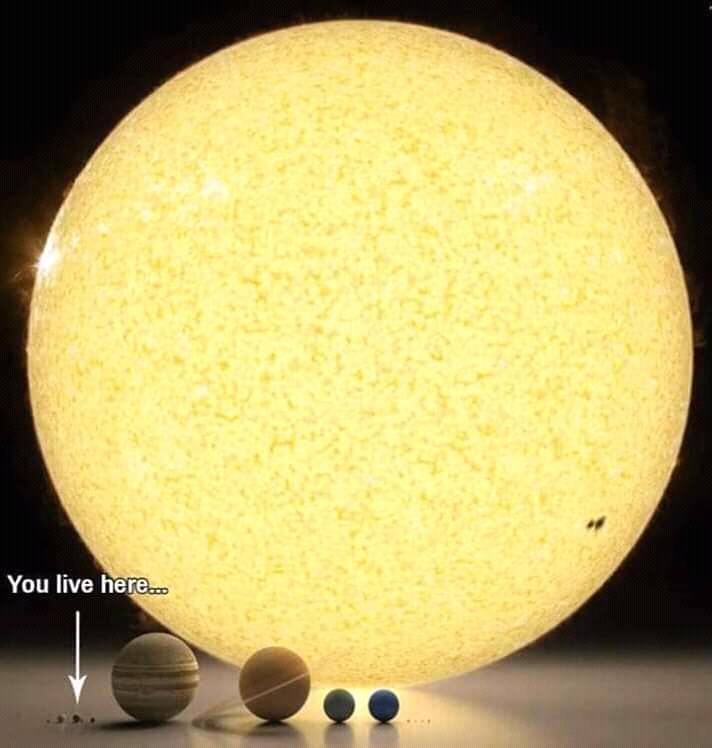
Size comparison of the Sun and the planets
The Sun is the Solar System’s star and by far its most massive component. Its large mass (332,900 Earth masses), which comprises 99.86% of all the mass in the Solar System, produces temperatures and densities in its core high enough to sustain nuclear fusion of hydrogen into helium, making it a main-sequence star. This releases an enormous amount of energy, mostly radiated into space as electromagnetic radiation peaking in visible light.

The Sun is a G2-type main-sequence star. Hotter main-sequence stars are more luminous. The Sun’s temperature is intermediate between that of the hottest stars and that of the coolest stars. Stars brighter and hotter than the Sun are rare, whereas substantially dimmer and cooler stars, known as red dwarfs, make up 85% of the stars in the Milky Way.

The Sun is a population I star; it has a higher abundance of elements heavier than hydrogen and helium (“metals” in astronomical parlance) than the older population II stars. Elements heavier than hydrogen and helium were formed in the cores of ancient and exploding stars, so the first generation of stars had to die before the Universe could be enriched with these atoms. The oldest stars contain few metals, whereas stars born later have more. This high metallicity is thought to have been crucial to the Sun’s development of a planetary system because the planets form from the accretion of “metals”.

Interplanetary medium

The heliospheric current sheet
The vast majority of the Solar System consists of a near-vacuum known as the interplanetary medium. Along with light, the Sun radiates a continuous stream of charged particles (a plasma) known as the solar wind. This stream of particles spreads outwards at roughly 1.5 million kilometres per hour, creating a tenuous atmosphere that permeates the interplanetary medium out to at least 100 AU (see § Heliosphere). Activity on the Sun’s surface, such as solar flares and coronal mass ejections, disturbs the heliosphere, creating space weather and causing geomagnetic storms. The largest structure within the heliosphere is the heliospheric current sheet, a spiral form created by the actions of the Sun’s rotating magnetic field on the interplanetary medium.

Earth’s magnetic field stops its atmosphere from being stripped away by the solar wind. Venus and Mars do not have magnetic fields, and as a result the solar wind is causing their atmospheres to gradually bleed away into space. Coronal mass ejections and similar events blow a magnetic field and huge quantities of material from the surface of the Sun. The interaction of this magnetic field and material with Earth’s magnetic field funnels charged particles into Earth’s upper atmosphere, where its interactions create aurorae seen near the magnetic poles.

The heliosphere and planetary magnetic fields (for those planets that have them) partially shield the Solar System from high-energy interstellar particles called cosmic rays. The density of cosmic rays in the interstellar medium and the strength of the Sun’s magnetic field change on very long timescales, so the level of cosmic-ray penetration in the Solar System varies, though by how much is unknown.

The interplanetary medium is home to at least two disc-like regions of cosmic dust. The first, the zodiacal dust cloud, lies in the inner Solar System and causes the zodiacal light. It was likely formed by collisions within the asteroid belt brought on by gravitational interactions with the planets. The second dust cloud extends from about 10 AU to about 40 AU, and was probably created by similar collisions within the Kuiper belt.

Inner Solar System
The inner Solar System is the region comprising the terrestrial planets and the asteroid belt. Composed mainly of silicates and metals, the objects of the inner Solar System are relatively close to the Sun; the radius of this entire region is less than the distance between the orbits of Jupiter and Saturn. This region is also within the frost line, which is a little less than 5 AU (about 700 million km) from the Sun.

Inner planets

The inner planets. From left to right: Earth, Mars, Venus, and Mercury (sizes to scale).

Orrery showing the motions of the inner four planets. The small spheres represent the position of each planet on every Julian day, beginning 6 July 2018 (aphelion) and ending 3 January 2019 (perihelion).
The four terrestrial or inner planets have dense, rocky compositions, few or no moons, and no ring systems. They are composed largely of refractory minerals, such as the silicates—which form their crusts and mantles—and metals, such as iron and nickel, which form their cores. Three of the four inner planets (Venus, Earth and Mars) have atmospheres substantial enough to generate weather; all have impact craters and tectonic surface features, such as rift valleys and volcanoes. The term inner planet should not be confused with inferior planet, which designates those planets that are closer to the Sun than Earth is (i.e. Mercury and Venus).

Mercury
Mercury (0.4 AU from the Sun) is the closest planet to the Sun and on average, all seven other planets. The smallest planet in the Solar System (0.055 M⊕), Mercury has no natural satellites. Besides impact craters, its only known geological features are lobed ridges or rupes that were probably produced by a period of contraction early in its history. Mercury’s very tenuous atmosphere consists of atoms blasted off its surface by the solar wind. Its relatively large iron core and thin mantle have not yet been adequately explained. Hypotheses include that its outer layers were stripped off by a giant impact, or that it was prevented from fully accreting by the young Sun’s energy.

Venus
Venus (0.7 AU from the Sun) is close in size to Earth (0.815 M⊕) and, like Earth, has a thick silicate mantle around an iron core, a substantial atmosphere, and evidence of internal geological activity. It is much drier than Earth, and its atmosphere is ninety times as dense. Venus has no natural satellites. It is the hottest planet, with surface temperatures over 400 °C (752 °F), most likely due to the amount of greenhouse gases in the atmosphere. No definitive evidence of current geological activity has been detected on Venus, but it has no magnetic field that would prevent depletion of its substantial atmosphere, which suggests that its atmosphere is being replenished by volcanic eruptions.

Earth
Earth (1 AU from the Sun) is the largest and densest of the inner planets, the only one known to have current geological activity, and the only place where life is known to exist. Its liquid hydrosphere is unique among the terrestrial planets, and it is the only planet where plate tectonics has been observed. Earth’s atmosphere is radically different from those of the other planets, having been altered by the presence of life to contain 21% free oxygen. It has one natural satellite, the Moon, the only large satellite of a terrestrial planet in the Solar System.

Mars
Mars (1.5 AU from the Sun) is smaller than Earth and Venus (0.107 M⊕). It has an atmosphere of mostly carbon dioxide with a surface pressure of 6.1 millibars (roughly 0.6% of that of Earth). Its surface, peppered with vast volcanoes, such as Olympus Mons, and rift valleys, such as Valles Marineris, shows geological activity that may have persisted until as recently as 2 million years ago. Its red colour comes from iron oxide (rust) in its soil. Mars has two tiny natural satellites (Deimos and Phobos) thought to be either captured asteroids, or ejected debris from a massive impact early in Mars’s history.

Asteroid belt

The donut-shaped asteroid belt is located between the orbits of Mars and Jupiter.
Sun
Jupiter trojans
Planetary orbit Asteroid belt
Hilda asteroids
NEOs (selection)
Asteroids except for the largest, Ceres, are classified as small Solar System bodies and are composed mainly of refractory rocky and metallic minerals, with some ice. They range from a few metres to hundreds of kilometres in size. Asteroids smaller than one meter are usually called meteoroids and micrometeoroids (grain-sized), depending on different, somewhat arbitrary definitions.

The asteroid belt occupies the orbit between Mars and Jupiter, between 2.3 and 3.3 AU from the Sun. It is thought to be remnants from the Solar System’s formation that failed to coalesce because of the gravitational interference of Jupiter. The asteroid belt contains tens of thousands, possibly millions, of objects over one kilometre in diameter. Despite this, the total mass of the asteroid belt is unlikely to be more than a thousandth of that of Earth. The asteroid belt is very sparsely populated; spacecraft routinely pass through without incident.

Ceres

Ceres – map of gravity fields: red is high; blue, low.
Ceres (2.77 AU) is the largest asteroid, a protoplanet, and a dwarf planet. It has a diameter of slightly under 1000 km, and a mass large enough for its own gravity to pull it into a spherical shape. Ceres was considered a planet when it was discovered in 1801, and was reclassified to asteroid in the 1850s as further observations revealed additional asteroids. It was classified as a dwarf planet in 2006 when the definition of a planet was created.

Asteroid groups
Asteroids in the asteroid belt are divided into asteroid groups and families based on their orbital characteristics. Asteroid moons are asteroids that orbit larger asteroids. They are not as clearly distinguished as planetary moons, sometimes being almost as large as their partners. The asteroid belt also contains main-belt comets, which may have been the source of Earth’s water.

Jupiter trojans are located in either of Jupiter’s L4 or L5 points (gravitationally stable regions leading and trailing a planet in its orbit); the term trojan is also used for small bodies in any other planetary or satellite Lagrange point. Hilda asteroids are in a 2:3 resonance with Jupiter; that is, they go around the Sun three times for every two Jupiter orbits.

The inner Solar System also contains near-Earth asteroids, many of which cross the orbits of the inner planets. Some of them are potentially hazardous objects.

Outer Solar System
The outer region of the Solar System is home to the giant planets and their large moons. The centaurs and many short-period comets also orbit in this region. Due to their greater distance from the Sun, the solid objects in the outer Solar System contain a higher proportion of volatiles, such as water, ammonia, and methane than those of the inner Solar System because the lower temperatures allow these compounds to remain solid.

Outer planets

The outer planets (in the background) Jupiter, Saturn, Uranus and Neptune, compared to the inner planets Earth, Venus, Mars and Mercury (in the foreground).

Orrery showing the motions of the outer four planets. The small spheres represent the position of each planet on every 100 Julian days, beginning 21 January 2023 (Jovian perihelion) and ending 2 December 2034 (Jovian perihelion).
The four outer planets, or giant planets (sometimes called Jovian planets), collectively make up 99% of the mass known to orbit the Sun. Jupiter and Saturn are together more than 400 times the mass of Earth and consist overwhelmingly of hydrogen and helium. Uranus and Neptune are far less massive—less than 20 Earth masses (M⊕) each—and are composed primarily of ices. For these reasons, some astronomers suggest they belong in their own category, ice giants. All four giant planets have rings, although only Saturn’s ring system is easily observed from Earth. The term superior planet designates planets outside Earth’s orbit and thus includes both the outer planets and Mars.

Jupiter
Jupiter (5.2 AU), at 318 M⊕, is 2.5 times the mass of all the other planets put together. It is composed largely of hydrogen and helium. Jupiter’s strong internal heat creates semi-permanent features in its atmosphere, such as cloud bands and the Great Red Spot. Jupiter has 79 known satellites. The four largest, Ganymede, Callisto, Io, and Europa, show similarities to the terrestrial planets, such as volcanism and internal heating. Ganymede, the largest satellite in the Solar System, is larger than Mercury.

Saturn
Saturn (9.5 AU), distinguished by its extensive ring system, has several similarities to Jupiter, such as its atmospheric composition and magnetosphere. Although Saturn has 60% of Jupiter’s volume, it is less than a third as massive, at 95 M⊕. Saturn is the only planet of the Solar System that is less dense than water. The rings of Saturn are made up of small ice and rock particles. Saturn has 82 confirmed satellites composed largely of ice. Two of these, Titan and Enceladus, show signs of geological activity. Titan, the second-largest moon in the Solar System, is larger than Mercury and the only satellite in the Solar System with a substantial atmosphere.

Uranus
Uranus (19.2 AU), at 14 M⊕, is the lightest of the outer planets. Uniquely among the planets, it orbits the Sun on its side; its axial tilt is over ninety degrees to the ecliptic. It has a much colder core than the other giant planets and radiates very little heat into space. Uranus has 27 known satellites, the largest ones being Titania, Oberon, Umbriel, Ariel, and Miranda.

Neptune
Neptune (30.1 AU), though slightly smaller than Uranus, is more massive (17 M⊕) and hence more dense. It radiates more internal heat, but not as much as Jupiter or Saturn. Neptune has 14 known satellites. The largest, Triton, is geologically active, with geysers of liquid nitrogen. Triton is the only large satellite with a retrograde orbit. Neptune is accompanied in its orbit by several minor planets, termed Neptune trojans, that are in 1:1 resonance with it.

Centaurs
The centaurs are icy comet-like bodies whose orbits have semi-major axes greater than Jupiter’s (5.5 AU) and less than Neptune’s (30 AU). The largest known centaur, 10199 Chariklo, has a diameter of about 250 km. The first centaur discovered, 2060 Chiron, has also been classified as comet (95P) because it develops a coma just as comets do when they approach the Sun.

Comets

Hale–Bopp seen in 1997
Comets are small Solar System bodies, typically only a few kilometres across, composed largely of volatile ices. They have highly eccentric orbits, generally a perihelion within the orbits of the inner planets and an aphelion far beyond Pluto. When a comet enters the inner Solar System, its proximity to the Sun causes its icy surface to sublimate and ionise, creating a coma: a long tail of gas and dust often visible to the naked eye.

Short-period comets have orbits lasting less than two hundred years. Long-period comets have orbits lasting thousands of years. Short-period comets are thought to originate in the Kuiper belt, whereas long-period comets, such as Hale–Bopp, are thought to originate in the Oort cloud. Many comet groups, such as the Kreutz Sungrazers, formed from the breakup of a single parent. Some comets with hyperbolic orbits may originate outside the Solar System, but determining their precise orbits is difficult. Old comets that have had most of their volatiles driven out by solar warming are often categorised as asteroids.

Trans-Neptunian region
Beyond the orbit of Neptune lies the area of the “trans-Neptunian region”, with the doughnut-shaped Kuiper belt, home of Pluto and several other dwarf planets, and an overlapping disc of scattered objects, which is tilted toward the plane of the Solar System and reaches much further out than the Kuiper belt. The entire region is still largely unexplored. It appears to consist overwhelmingly of many thousands of small worlds—the largest having a diameter only a fifth that of Earth and a mass far smaller than that of the Moon—composed mainly of rock and ice. This region is sometimes described as the “third zone of the Solar System”, enclosing the inner and the outer Solar System.

Kuiper belt

Known objects in the Kuiper belt
Sun
Jupiter trojans
Giant planets Kuiper belt
Scattered disc
Neptune trojans

Size comparison of some large TNOs with Earth: Pluto and its moons, Eris, Makemake, Haumea, Sedna, Gonggong, Quaoar, and Orcus.
The Kuiper belt is a great ring of debris similar to the asteroid belt, but consisting mainly of objects composed primarily of ice. It extends between 30 and 50 AU from the Sun. Though it is estimated to contain anything from dozens to thousands of dwarf planets, it is composed mainly of small Solar System bodies. Many of the larger Kuiper belt objects, such as Quaoar, Varuna, and Orcus, may prove to be dwarf planets with further data. There are estimated to be over 100,000 Kuiper belt objects with a diameter greater than 50 km, but the total mass of the Kuiper belt is thought to be only a tenth or even a hundredth the mass of Earth. Many Kuiper belt objects have multiple satellites, and most have orbits that take them outside the plane of the ecliptic.

The Kuiper belt can be roughly divided into the “classical” belt and the resonances. Resonances are orbits linked to that of Neptune (e.g. twice for every three Neptune orbits, or once for every two). The first resonance begins within the orbit of Neptune itself. The classical belt consists of objects having no resonance with Neptune, and extends from roughly 39.4 AU to 47.7 AU. Members of the classical Kuiper belt are classified as cubewanos, after the first of their kind to be discovered, 15760 Albion (which previously had the provisional designation 1992 QB1), and are still in near primordial, low-eccentricity orbits.

Pluto and Charon
The dwarf planet Pluto (39 AU average) is the largest known object in the Kuiper belt. When discovered in 1930, it was considered to be the ninth planet; this changed in 2006 with the adoption of a formal definition of planet. Pluto has a relatively eccentric orbit inclined 17 degrees to the ecliptic plane and ranging from 29.7 AU from the Sun at perihelion (within the orbit of Neptune) to 49.5 AU at aphelion. Pluto has a 3:2 resonance with Neptune, meaning that Pluto orbits twice round the Sun for every three Neptunian orbits. Kuiper belt objects whose orbits share this resonance are called plutinos.

Charon, the largest of Pluto’s moons, is sometimes described as part of a binary system with Pluto, as the two bodies orbit a barycentre of gravity above their surfaces (i.e. they appear to “orbit each other”). Beyond Charon, four much smaller moons, Styx, Nix, Kerberos, and Hydra, orbit within the system.

Makemake and Haumea
Makemake (45.79 AU average), although smaller than Pluto, is the largest known object in the classical Kuiper belt (that is, a Kuiper belt object not in a confirmed resonance with Neptune). Makemake is the brightest object in the Kuiper belt after Pluto. It was assigned a naming committee under the expectation that it would prove to be a dwarf planet in 2008. Its orbit is far more inclined than Pluto’s, at 29°.

Haumea (43.13 AU average) is in an orbit similar to Makemake, except that it is in a temporary 7:12 orbital resonance with Neptune. It was named under the same expectation that it would prove to be a dwarf planet, though subsequent observations have indicated that it may not be a dwarf planet after all.

Scattered disc
The scattered disc, which overlaps the Kuiper belt but extends out to about 200 AU, is thought to be the source of short-period comets. Scattered-disc objects are thought to have been ejected into erratic orbits by the gravitational influence of Neptune’s early outward migration. Most scattered disc objects (SDOs) have perihelia within the Kuiper belt but aphelia far beyond it (some more than 150 AU from the Sun). SDOs’ orbits are also highly inclined to the ecliptic plane and are often almost perpendicular to it. Some astronomers consider the scattered disc to be merely another region of the Kuiper belt and describe scattered disc objects as “scattered Kuiper belt objects”. Some astronomers also classify centaurs as inward-scattered Kuiper belt objects along with the outward-scattered residents of the scattered disc.

Eris
Eris (68 AU average) is the largest known scattered disc object, and caused a debate about what constitutes a planet, because it is 25% more massive than Pluto and about the same diameter. It is the most massive of the known dwarf planets. It has one known moon, Dysnomia. Like Pluto, its orbit is highly eccentric, with a perihelion of 38.2 AU (roughly Pluto’s distance from the Sun) and an aphelion of 97.6 AU, and steeply inclined to the ecliptic plane.

Farthest regions

From the Sun to the nearest star: The Solar System on a logarithmic scale in astronomical units (AU)
The point at which the Solar System ends and interstellar space begins is not precisely defined because its outer boundaries are shaped by two separate forces: the solar wind and the Sun’s gravity. The limit of the solar wind’s influence is roughly four times Pluto’s distance from the Sun; this heliopause, the outer boundary of the heliosphere, is considered the beginning of the interstellar medium. The Sun’s Hill sphere, the effective range of its gravitational dominance, is thought to extend up to a thousand times farther and encompasses the theorized Oort cloud.

Heliosphere

The bubble-like heliosphere with its various transitional regions moving through the interstellar medium
The heliosphere is a stellar-wind bubble, a region of space dominated by the Sun, which radiates at roughly 400 km/s its solar wind, a stream of charged particles, until it collides with the wind of the interstellar medium.

The collision occurs at the termination shock, which is roughly 80–100 AU from the Sun upwind of the interstellar medium and roughly 200 AU from the Sun downwind. Here the wind slows dramatically, condenses and becomes more turbulent, forming a great oval structure known as the heliosheath. This structure is thought to look and behave very much like a comet’s tail, extending outward for a further 40 AU on the upwind side but tailing many times that distance downwind; evidence from Cassini and Interstellar Boundary Explorer spacecraft has suggested that it is forced into a bubble shape by the constraining action of the interstellar magnetic field.

The outer boundary of the heliosphere, the heliopause, is the point at which the solar wind finally terminates and is the beginning of interstellar space. Voyager 1 and Voyager 2 are reported to have passed the termination shock and entered the heliosheath, at 94 and 84 AU from the Sun, respectively. Voyager 1 is reported to have crossed the heliopause in August 2012.

The shape and form of the outer edge of the heliosphere is likely affected by the fluid dynamics of interactions with the interstellar medium as well as solar magnetic fields prevailing to the south, e.g. it is bluntly shaped with the northern hemisphere extending 9 AU farther than the southern hemisphere. Beyond the heliopause, at around 230 AU, lies the bow shock, a plasma “wake” left by the Sun as it travels through the Milky Way.

Zooming out the Solar System:
inner Solar System and Jupiter
outer Solar System and Pluto
orbit of Sedna (detached object)
inner part of the Oort Cloud
Due to a lack of data, conditions in local interstellar space are not known for certain. It is expected that NASA’s Voyager spacecraft, as they pass the heliopause, will transmit valuable data on radiation levels and solar wind to Earth. How well the heliosphere shields the Solar System from cosmic rays is poorly understood. A NASA-funded team has developed a concept of a “Vision Mission” dedicated to sending a probe to the heliosphere
Ozone Layer(ওজোন স্তর)

ওজোন স্তর

শিরোনামের বিবরণ যোগ করুন


ওজোন স্তর (Ozone layer) হচ্ছে পৃথিবীর বায়ুমন্ডলের একটি স্তর যেখানে তুলনামূলকভাবে বেশি মাত্রায় ওজোন গ্যাসথাকে। এই স্তর থাকে প্রধানতঃ স্ট্র্যাটোস্ফিয়ারের নিচের অংশে, যা ভূপৃষ্ঠ থেকে কমবেশি ২০-৩০ কিমি উপরে অবস্থিত। এই স্তরের পুরুত্ব স্থানভেদে এবং মৌসুমভেদেকমবেশি হয়। O2 + ℎνuv → 2OO + O2 ↔ O3Brewer-Dobson circulation in the ozone layer.Layers of Atmosphere – not to scale (NOAA)

বায়ুমণ্ডলে ওজোনের প্রায় ৯০ শতাংশ স্ট্রাটোস্ফিয়ারের মধ্যে অন্তর্ভুক্ত করা হয়। ওজোন কেন্দ্রীকরণ প্রায় ২০ এবং ৪০ কিলোমিটার (৬৬,০০০ এবং ১৩১,০০০ ফুট), তারা যেখানে মিলিয়ন প্রতি প্রায় ২ থেকে ৮ অংশ থেকে পরিসীমার মধ্যে সর্বশ্রেষ্ঠ হয়। যদি এই ওজোনের সবটুকু অংশ সমুদ্রতল এর বায়ু চাপ দ্বারা সংকুচিত করা হয় তাহলে এটি শুধুমাত্র ৩ মিলিমিটার (১/৮ ইঞ্চি) পুরু হবে!

ইতিহাস

ফরাসী পদার্থবিদ চার্লস ফ্যব্রি এবং হেনরি বুইসন ১৯৩০ সালে ওজোন স্তর আবিষ্কার করেন। পরবর্তীতে ব্রিটিশ আবহাওয়াবিদ জি এম বি ডবসন ওজোনস্তর নিয়ে বিস্তর গবেষণা করেন। ১৯২৮ সাল থেকে ১৯৫৮ সালের মধ্যে তিনি ওজোন পর্যবেক্ষণ স্টেশনসমূহের একটি নেটওয়ার্ক তৈরি করেন।

গুরুত্ব

ওজোনস্তরে ওজোনের ঘনত্ব খুবই কম হলেও জীবনের জন্যে এটি খুবই গুরুত্বপূর্ণ। সূর্য থেকে আগত ক্ষতিকর অতিবেগুনী রশ্মি এটি শোষণ করে নেয়। ওজোন স্তর সূর্যের ক্ষতিকর মধ্যম মাত্রার(তরঙ্গদৈর্ঘ্যের) শতকরা ৯৭-৯৯ অংশই শোষণ করে নেয়, যা কিনা ভূ-পৃষ্ঠে অবস্থানরত উদ্ভাসিত জীবনসমূহের সমূহ ক্ষতিসাধন করতে সক্ষম। মধ্যম তরঙ্গদৈর্ঘ্যের সূর্যের এই অতিবেগুণী রশ্মি মানব দেহের ত্বক এমনকি হাড়ের ক্যান্সার সহ অন্যান্য মারাত্মক ব্যাধি সৃষ্টিতে সমর্থ। এই ক্ষতিকর রশ্মি পৃথিবীর জীবজগতের সকল প্রাণের প্রতি তীব্র হুমকি স্বরূপ। বায়ুমন্ডলের ওজোন স্তর প্রতিনিয়তই এই মারাত্নক ক্ষতিকর অতিবেগুণী রশ্নিগুলোকে প্রতিহত করে পৃথিবীর প্রাণিকুলকে রক্ষা করছে।

ওজোন স্তরের অত্যন্ত গুরুত্বপূর্ণ এই ভূমিকার জন্য জাতিসংঘ সাধারণ পরিষদের অধিবেশনে ওজোন লেয়ার সংরক্ষণের জন্য আন্তর্জাতিক দিবস হিসেবে সেপ্টেম্বরের ১৬ তারিখটি মনোনীত করেছে।

CORONAVIRUS(করোনাভাইরাস)

করোনাভাইরাস

ভাইরাসের একটি উপ-পরিবার


করোনাভাইরাস বলতে ভাইরাসের একটি শ্রেণীকে বোঝায় যেগুলি স্তন্যপায়ী প্রাণী এবংপাখিদেরকে আক্রান্ত করে। মানুষের মধ্যে করোনাভাইরাস শ্বাসনালীর সংক্রমণ ঘটায়। এই সংক্রমণের লক্ষণ মৃদু হতে পারে, অনেকসময় যা সাধারণ সর্দিকাশির ন্যায় মনে হয় (এছাড়া অন্য কিছুও হতে পারে, যেমন রাইনোভাইরাস), কিছু ক্ষেত্রে তা অন্যান্য মারাত্মক ভাইরাসের জন্য হয়ে থাকে, যেমন সার্স, মার্স এবংকোভিড-১৯। অন্যান্য প্রজাতিতে এই লক্ষণের তারতম্য দেখা যায়। যেমন মুরগির মধ্যে এটাউর্ধ্ব শ্বাসনালী সংক্রমণ ঘটায়, আবার গরু ও শূকরে এটি ডায়রিয়া সৃষ্টি করে। মানবদেহে সৃষ্ট করোনাভাইরাস সংক্রমণ এড়ানোর মত কোনোটিকা বা অ্যান্টিভাইরাল ওষুধ আজও আবিষ্কৃত হয়নি।দ্রুত তথ্য: করোনাভাইরাস, ভাইরাসের শ্রেণীবিন্যাস …

করোনাভাইরাস রাইবোভিরিয়া পর্বেরনিদুভাইরাস বর্গের করোনাভিরিডি গোত্রেরঅর্থোকরোনাভিরিন্যা উপ-গোত্রের সদস্য।তারা পজিটিভ সেন্স একক সূত্রবিশিষ্টআবরণীবদ্ধ বা এনভেলপড ভাইরাস। তাদেরনিউক্লিওক্যাপসিড সর্পিলাকৃতির। এর জিনোমের আকার সাধারণত ২৭ থেকে ৩৪কিলো বেস-পেয়ার (kilo base-pair) এর মধ্যে হয়ে থাকে যা এ ধরনের আরএনএ ভাইরাসেরমধ্যে সর্ববৃহৎ। করোনাভাইরাস শব্দটি ল্যাটিন ভাষার করোনা থেকে নেওয়া হয়েছে যার অর্থ “মুকুট”। কারণ দ্বিমাত্রিক সঞ্চালন ইলেকট্রন অণুবীক্ষণ যন্ত্রে ভাইরাসটির আবরণ থেকে গদা-আকৃতির প্রোটিনের কাঁটাগুলির কারণে এটিকে অনেকটা মুকুট বা সৌর করোনার মত দেখায়। ভাইরাসের উপরিভাগ প্রোটিন সমৃদ্ধ থাকে যা ভাইরাল স্পাইক পেপলোমার দ্বারা এরঅঙ্গসংস্থান গঠন করে। এ প্রোটিন সংক্রমিত হওয়া টিস্যু বিনষ্ট করে। ভাইরাসটি ডাইমরফিজম রূপ প্রকাশ করে। ধারনা করা হয়, প্রাণীর দেহ থেকে এই ভাইরাস প্রথম মানবদেহে প্রবেশ করে।

ইতিহাস

করোনাভাইরাস ১৯৬০-এর দশকে প্রথম আবিষ্কৃত হয়। প্রথমদিকে মুরগির মধ্যে সংক্রামক ব্রঙ্কাইটিস ভাইরাস হিসেবে এটি প্রথম দেখা যায়। পরে সাধারণ সর্দি-হাঁচি-কাশিতে আক্রান্ত রোগীদের মধ্যে এরকম দুই ধরনের ভাইরাস পাওয়া যায়। মানুষের মধ্যে পাওয়া ভাইরাস দুটি ‘মনুষ্য করোনাভাইরাস ২২৯ই’ এবং ‘মনুষ্য করোনাভাইরাস ওসি৪৩’ নামে নামকরণ করা হয়। এরপর থেকে বিভিন্ন সময় ভাইরাসটির আরো বেশ কিছু প্রজাতি পাওয়া যায় যার মধ্যে উল্লেখযোগ্য হলো ২০০৩ সালে ‘এসএআরএস-সিওভি’, ২০০৪ সালে ‘এইচসিওভি এনএল৬৩’, ২০০৫ সালে ‘এইচকেইউ১’, ২০১২ সালে ‘এমইআরএস-সিওভি’ এবং সর্বশেষ ২০১৯ সাল চীনে এসএআরএস-সিওভি-২’ পাওয়া যায়(যা বর্তমানে সাধারণত নোভেল করোনাভাইরাস নামেই পরিচিত। এগুলোর মধ্যে অধিকাংশ ভাইরাসের ফলে শ্বাসকষ্টের গুরুতর সংক্রমণ দেখা দেয়।

করোনাভাইরাসে আক্রান্ত ব্যক্তির প্রাথমিক লক্ষণ

  • জ্বর
  • অবসাদ
  • শুষ্ক কাশি
  • বমি হওয়া
  • শ্বাসকষ্ট
  • গলা ব্যাথা
  • অঙ্গ বিকল হওয়া
  • মাথা ব্যাথা
  • পেটের সমস্যা
  • কিছু রোগীর ক্ষেত্রে উপরোক্ত সকল উপসর্গ দেখা গেলেও জ্বর থাকেনা।

করোনাভাইরাসের প্রাদুর্ভাব (২০১৯-২০২০)

২০১৯ সালের ৩১ ডিসেম্বরে চীনের উহান শহরেকরোনাভাইরাসের একটি প্রজাতির সংক্রামণদেখা দেয়। বিশ্ব স্বাস্থ্য সংস্থা ভাইরাসটিকে প্রাতিষ্ঠানিকভাবে ‘২০১৯-এনসিওভি’ নামকরণ করে। ২০২০ সালের ২৭ মার্চ পর্যন্ত প্রাপ্ত তথ্য অনুযায়ী বিশ্বের ২০৪টিরও বেশি দেশ ও অধীনস্থ অঞ্চলে ৫,৩২,১০০ (পাঁচ লক্ষ বত্রিশ হাজার একশত)-এরও বেশি ব্যক্তি করোনাভাইরাস রোগ ২০১৯-এ আক্রান্ত হয়েছেন বলে সংবাদ প্রতিবেদনে প্রকাশ পেয়েছে। এদের মধ্যে ৯৫ হাজার জনের বেশী ব্যক্তির মৃত্যু ঘটেছে এবং ১ লাখ ২৪ হাজারের বেশি রোগী সুস্থ হয়ে উঠেছে।

উহানে দেখা দেওয়া ভাইরাস প্রজাতিটি ‘এসএআরএস-সিওভি’ প্রজাতির সাথে ~৭০% জিনগত মিল পাওয়া যায়। অনেকেই অনুমান করছেন নতুন এ প্রজাতিটি সাপ থেকে এসেছে যদিও অনেক গবেষক এ মতের বিরোধীতা করেন।

শব্দতত্ত্ব

“করোনাভাইরাস” নামটির উৎপত্তি লাতিন শব্দকরোনা থেকে যার অর্থ “মুকুট” বা “হার”। করোনা শব্দটি নিজে গ্রিক κορώνη korṓnē থেকে এসেছে যার অর্থ “মালা” বা “হার”। নামটি ইলেক্ট্রন মাইক্রোস্কোপের মাধ্যমে ভিরিয়নের (ভাইরাসের সংক্রামক আকার) বৈশিষ্ট্যমূলক উপস্থিতিকে নির্দেশ করে। ভিরিয়নের বিশাল কন্দাকৃতি পৃষ্ঠ অভিক্ষেপযুক্ত প্রান্ত রয়েছে যা মুকুটের স্মৃতি তৈরি করে। এর অঙ্গসংস্থান ভাইরাল স্পাইক পেপলোমিয়ার দ্বারা তৈরি হয়েছে যেগুলো মূলত ভাইরাসের পৃষ্ঠে অবস্থিত প্রোটিন।

অঙ্গসংস্থান

করোনাভাইরাসের প্রস্থচ্ছেদ

করোনাভাইরাস বাল্বাস পৃষ্ঠের সাথে প্লিওমরফিক গোলাকার কণাসদৃশ। ভাইরাস কণার ব্যাস প্রায় ১২০ ন্যানোমিটার। ইলেক্ট্রন মাইক্রোগ্রাফগুলিতে ভাইরাসের আচ্ছাদনটি ইলেক্ট্রন গাঢ় শাঁসগুলির একটি পৃথক জোড়া হিসাবে উপস্থিত হয়।

সকল প্রজাতির করোনাভাইরাসে সাধারণত স্পাইক (এস), এনভেলপ (ই), মেমব্রেন (এম) এবং নিউক্লিওক্যাপসিড (এন) নামক চার ধরনের প্রোটিন দেখা যায়। ভাইরাল আচ্ছাদনে একটি লিপিড বাইলেয়ার থাকে যেখানে মেমব্রেন (এম), এনভেলপ (ই) এবং স্পাইক (এস) কাঠামোগত অ্যাংকর প্রোটিন থাকে।করোনাভাইরাসগুলির একটি উপসেট (বিশেষত বিটাকরোনাভাইরাস “সাবগ্রুপ এ”-এর ​​সদস্যদের) হিমাগ্লুটিনিন অ্যাস্টেরেস নামে একটি সংক্ষিপ্ত স্পাইক-জাতীয় পৃষ্ঠ-প্রোটিন রয়েছে।

জিনোম

জিনোম অর্গানাইজেশনের পরিকল্পনামূলক উপস্থাপনা এবং SARS-CoV এবং MERS-CoV এর S প্রোটিনের কার্যকরী ডোমেন।

করোনাভাইরাসে একটি পজিটিভ সেন্স, এক-সূত্রক আরএনএ জিনোম থাকে। করোনাভাইরাসগুলির জিনোমের আকার প্রায় ২৭ থেকে ৩৪ কিলোবেইজের মধ্যে থাকে।আরএনএ ভাইরাসগুলির মধ্যে এটির জিনোমের আকার একটি বৃহত্তম। জিনোমে একটি 5′ মিথাইলিটেড ক্যাপ এবং 3′ পলি অ্যাডেনিলেটেড লেজ থাকে।

একটি করোনাভাইরাসের জন্য জিনোম অর্গানাইজেশন হলো 5′-লিডার-UTR (Untranslated Region) -রেপ্লিকেজ/ ট্রান্সক্রিপটেজ-স্পাইক (S) – এনভেলপ (E) – মেমব্রেন (M) – নিউক্লিওক্যাপসিড (এন) – 3’UTR – পলি (A) লেজ। মুক্ত রিডিং ফ্রেম 1a এবং 1b জিনোমের প্রথম দুই-তৃতীয়াংশ দখল করে এবং রেপ্লিকেজ/ট্রান্সক্রিপটেজ পলিপ্রোটিন এনকোড করে। রেপ্লিকেজ/ট্রান্সক্রিপটেজ পলিপ্রোটিন নিজে থেকেই ভেঙে গিয়ে অ-গাঠনিক প্রোটিন (Nonstructural Proteins, nsps) গঠন করে। 

পরবর্তী রিডিং ফ্রেমগুলি চারটি প্রধান গাঠনিক প্রোটিন: স্পাইক, এনভেলপ, মেমব্রেন এবং নিউক্লিওক্যাপসিডকে এনকোড করে। এই রিডিং ফ্রেমগুলোর মধ্যে বিক্ষিপ্ত ফ্রেমগুলো হল আনুষঙ্গিক প্রোটিনগুলির জন্য রিডিং ফ্রেম। নির্দিষ্ট করোনভাইরাসের জন্য তার আনুষঙ্গিক প্রোটিনগুলির সংখ্যা এবং কার্যাবলী নির্দিষ্ট।

জীবনচক্র

অনুপ্রবেশ

The life cycle of a coronavirus

সংক্রমণ শুরু হয় যখন ভাইরাল স্পাইক (S) গ্লাইকোপ্রোটিন পরিপূরক বাহক কোষের রিসিপ্টরে সংযুক্ত হয়। সংযুক্তির পর, বাহক কোষ থেকে নিঃসৃত প্রোটিয়েজ, রিসিপ্টর-সংযুক্ত স্পাইক প্রোটিনকে বিদীর্ণ করে এবং সক্রিয় করে দেয়। বাহক কোষের প্রোটিয়েজের প্রাপ্তিসাপেক্ষ, বিচ্ছিন্নকরণ ও সক্রিয়করণ নির্ধারণ করে ভাইরাসটি বাহক কোষে অনুপ্রবেশ করবে এন্ডোসাইটোসিস নাকি বাহক কোষঝিল্লি এর সাথে ভাইরাল এনভেলপ সরাসরি একীভূত হওয়ার মাধ্যমে।

বাহক কোষে অনুপ্রবেশ করে, ভাইরাস কণাটিআবরণী মুক্ত হয় এবং কোষ সাইটোপ্লাজমে এরজিনোম প্রবেশ করে। করোনা ভাইরাস RNA জিনোমে একটি ৫’ মিথাইলেটেড ক্যাপ এবং ৩’ পলিয়াডেনাইলেটেড টেইল আছে, যা RNA কেট্রান্সলেশনের জন্য বাহক কোষের রাইবোজোম এর সাথে সংযুক্ত করে। ভাইরাসের প্রাথমিকভাবে অধিক্রমণকারী উন্মুক্ত পঠন কাঠামো, বাহক রাইবোজোম ট্রান্সলেশন করে দীর্ঘ পলিপ্রোটিন গঠন করে। পলিপ্রোটিনের নিজস্ব প্রোটিয়েজ আছে যা পলিপ্রোটিনটিকেবিদীর্ণ করে অনেকগুলো অগঠনমূলক প্রোটিনতৈরি করে।

National space center

The National Space Centre is a museum and educational resource covering the fields of space science and astronomy, along with a space research programme in partnership with the University of Leicester. It is located on the north side the city of Leicester, England, next to the River Soar. Many of the exhibits, including upright rockets, are housed in a tower with minimal steel supports and a semi-transparent cladding of ETFE‘pillows’ which has become one of Leicester’s most recognisable landmarks.

National space center

The National Space Centre is a museum and educational resource covering the fields of space science and astronomy, along with a space research programme in partnership with the University of Leicester. It is located on the north side the city of Leicester, England, next to the River Soar. Many of the exhibits, including upright rockets, are housed in a tower with minimal steel supports and a semi-transparent cladding of ETFE‘pillows’ which has become one of Leicester’s most recognisable landmarks.

Barmuda triangle

Bermuda Triangle

Region in the western part of the North Atlantic Ocean


The Bermuda Triangle, also known as the Devil’s Triangle or Hurricane Alley, is a loosely defined region in the western part of the North Atlantic Ocean where a number of aircraft and ships are said to have disappeared under mysterious circumstances. Most reputable sources dismiss the idea that there is any mystery.Quick facts: Coordinates …

The vicinity of the Bermuda Triangle is amongst the most heavily traveled shipping lanes in the world, with ships frequently crossing through it for ports in the Americas, Europe and the Caribbean islands. Cruise ships and pleasure craft regularly sail through the region, and commercial and private aircraft routinely fly over it.

Popular culture has attributed various disappearances to the paranormal or activity by extraterrestrial beings. Documented evidence indicates that a significant percentage of the incidents were spurious, inaccurately reported, or embellished by later authors.

Origins

The earliest suggestion of unusual disappearances in the Bermuda area appeared in a September 17, 1950, article published in The Miami Herald(Associated Press) by Edward Van Winkle Jones. Two years later, Fatemagazine published “Sea Mystery at Our Back Door”, a short article by George Sand covering the loss of several planes and ships, including the loss of Flight 19, a group of five US Navy Grumman TBM Avenger torpedo bombers on a training mission. Sand’s article was the first to lay out the now-familiar triangular area where the losses took place. Flight 19 alone would be covered again in the April 1962 issue of American Legionmagazine. In it, author Allan W. Eckertwrote that the flight leader had been heard saying, “We are entering white water, nothing seems right. We don’t know where we are, the water is green, no white.” He also wrote that officials at the Navy board of inquiry stated that the planes “flew off to Mars.” Sand’s article was the first to suggest a supernatural element to the Flight 19 incident.

In February 1964, Vincent Gaddis wrote an article called “The Deadly Bermuda Triangle” in the pulp magazine Argosysaying Flight 19 and other disappearances were part of a pattern of strange events in the region. The next year, Gaddis expanded this article into a book, Invisible Horizons.

Other writers elaborated on Gaddis’ ideas: John Wallace Spencer (Limbo of the Lost, 1969, repr. 1973); Charles Berlitz (The Bermuda Triangle, 1974);Richard Winer (The Devil’s Triangle, 1974), and many others, all keeping to some of the same supernatural elements outlined by Eckert.

Triangle area

The Gaddis Argosy article delineated the boundaries of the triangle, giving itsvertices as MiamiSan JuanPuerto Rico; and Bermuda. Subsequent writers did not necessarily follow this definition.Some writers gave different boundaries and vertices to the triangle, with the total area varying from 1,300,000 to 3,900,000 km2 (500,000 to 1,510,000 sq mi). “Indeed, some writers even stretch it as far as the Irish coast.” Consequently, the determination of which accidents occurred inside the triangle depends on which writer reported them.

Criticism of the concept

Larry Kusche

Larry Kusche, author of The Bermuda Triangle Mystery: Solved (1975)argued that many claims of Gaddis and subsequent writers were exaggerated, dubious or unverifiable. Kusche’s research revealed a number of inaccuracies and inconsistencies between Berlitz’s accounts and statements from eyewitnesses, participants, and others involved in the initial incidents. Kusche noted cases where pertinent information went unreported, such as the disappearance of round-the-world yachtsman Donald Crowhurst, which Berlitz had presented as a mystery, despite clear evidence to the contrary. Another example was the ore-carrier recounted by Berlitz as lost without trace three days out of anAtlantic port when it had been lost three days out of a port with the same name in the Pacific Ocean. Kusche also argued that a large percentage of the incidents that sparked allegations of the Triangle’s mysterious influence actually occurred well outside it. Often his research was simple: he would review period newspapers of the dates of reported incidents and find reports on possibly relevant events like unusual weather, that were never mentioned in the disappearance stories.

Kusche concluded that:

  • The number of ships and aircraft reported missing in the area was not significantly greater, proportionally speaking, than in any other part of the ocean.
  • In an area frequented by tropical cyclones, the number of disappearances that did occur were, for the most part, neither disproportionate, unlikely, nor mysterious.
  • Furthermore, Berlitz and other writers would often fail to mention such storms or even represent the disappearance as having happened in calm conditions when meteorological records clearly contradict this.
  • The numbers themselves had been exaggerated by sloppy research. A boat’s disappearance, for example, would be reported, but its eventual (if belated) return to port may not have been.
  • Some disappearances had, in fact, never happened. One plane crash was said to have taken place in 1937, offDaytona Beach, Florida, in front of hundreds of witnesses; a check of the local papers revealed nothing.[citation needed]
  • The legend of the Bermuda Triangle is a manufactured mystery, perpetuated by writers who either purposely or unknowingly made use of misconceptions, faulty reasoning, and sensationalism.

In a 2013 study, the World Wide Fund for Nature identified the world’s 10 most dangerous waters for shipping, but the Bermuda Triangle was not among them.

Astronomy

Sun

Star at the center of the Solar System


The Sun is the star at the center of theSolar System. It is a nearly perfectsphere of hot plasma, with internalconvective motion that generates amagnetic field via a dynamo process.It is by far the most important source ofenergy for life on Earth. Its diameter is about 1.39 million kilometers (864,000 miles), or 109 times that of Earth, and its mass is about 330,000 times that of Earth. It accounts for about 99.86% of the total mass of the Solar System.Roughly three quarters of the Sun’s mass consists of hydrogen (~73%); the rest is mostly helium (~25%), with much smaller quantities of heavier elements, including oxygencarbonneon, and iron.Quick facts: Escape velocity (from the surface), Names …

The Sun is a G-type main-sequence star(G2V) based on its spectral class. As such, it is informally and not completely accurately referred to as a yellow dwarf(its light is closer to white than yellow). It formed approximately 4.6 billionyears ago from the gravitational collapseof matter within a region of a largemolecular cloud. Most of this matter gathered in the center, whereas the rest flattened into an orbiting disk thatbecame the Solar System. The central mass became so hot and dense that it eventually initiated nuclear fusion in itscore. It is thought that almost all starsform by this process.

The Sun currently fuses about 600 million tons of hydrogen into heliumevery second, converting 4 million tons of matter into energy every second as a result. This energy, which can take between 10,000 and 170,000 years to escape from its core, is the source of the Sun’s light and heat. When hydrogen fusion in its core has diminished to the point at which the Sun is no longer inhydrostatic equilibrium, its core will undergo a marked increase in density and temperature while its outer layers expand, eventually transforming the Sun into a red giant. It is calculated that the Sun will become sufficiently large to engulf the current orbits of Mercury andVenus, and render Earth uninhabitable – but not for about five billion years. After this, it will shed its outer layers and become a dense type of cooling star known as a white dwarf, and no longer produce energy by fusion, but still glow and give off heat from its previous fusion.

The enormous effect of the Sun on Earth has been recognized since prehistoric times, and the Sun has been regarded by some cultures as a deity. The synodicrotation of Earth and its orbit around the Sun are the basis of solar calendars, one of which is the predominant calendar in use today.

Name and et

Mariana trench

Mariana Trench

The deepest part of Earth’s oceans, where the Pacific Plate is subducted under the Mariana Plate


The Mariana Trench or Marianas Trench is located in the westernPacific Ocean about 200 kilometres (124 mi) east of the Mariana Islands; it is the deepest trench on Earth. It is crescent-shaped and measures about2,550 km (1,580 mi) in length and 69 km (43 mi) in width. The maximum known depth is 10,984 metres (36,037 ft) (± 25 metres [82 ft]) at the southern end of a small slot-shaped valley in its floor known as the Challenger Deep.However, some unrepeated measurements place the deepest portion at 11,034 metres (36,201 ft). By comparison: if Mount Everest were placed into the trench at this point, its peak would still be over two kilometres (1.2 mi) under water.Location of the Mariana Trench

At the bottom of the trench the water column above exerts a pressure of 1,086 bars (15,750 psi), more than 1,071 times the standard atmospheric pressure at sea level. At this pressure, the density of water is increased by 4.96%. The temperature at the bottom is 1 to 4 °C (34 to 39 °F).

The trench is not the part of the seafloor closest to the center of the Earth. This is because the Earth is an oblate spheroid, not a perfect sphere; its radius is about25 kilometres (16 mi) smaller at the poles than at the equator. As a result, parts of the Arctic Ocean seabed are at least 13 kilometres (8.1 mi) closer to the Earth’s center than the Challenger Deep seafloor.[citation needed]

In 2009, the Marianas Trench was established as a United States National MonumentMonothalamea have been found in the trench by Scripps Institution of Oceanography researchers at a record depth of 10.6 kilometres (6.6 mi) below the sea surface. Data has also suggested that microbial life formsthrive within the trench.

Names

The Mariana Trench is named after the nearby Mariana Islands (in turn named Las Marianas in honor of Spanish QueenMariana of Austria, widow of Philip IV of Spain). The islands are part of the island arc that is formed on an over-riding plate, called the Mariana Plate (also named for the islands), on the western side of the trench.

Geology

The Pacific plate is subducted beneath the Mariana Plate, creating the Mariana trench, and (further on) the arc of the Mariana Islands, as water trapped in the plate is released and explodes upward to form island volcanoes and earthquakes .

Design a site like this with WordPress.com
Get started